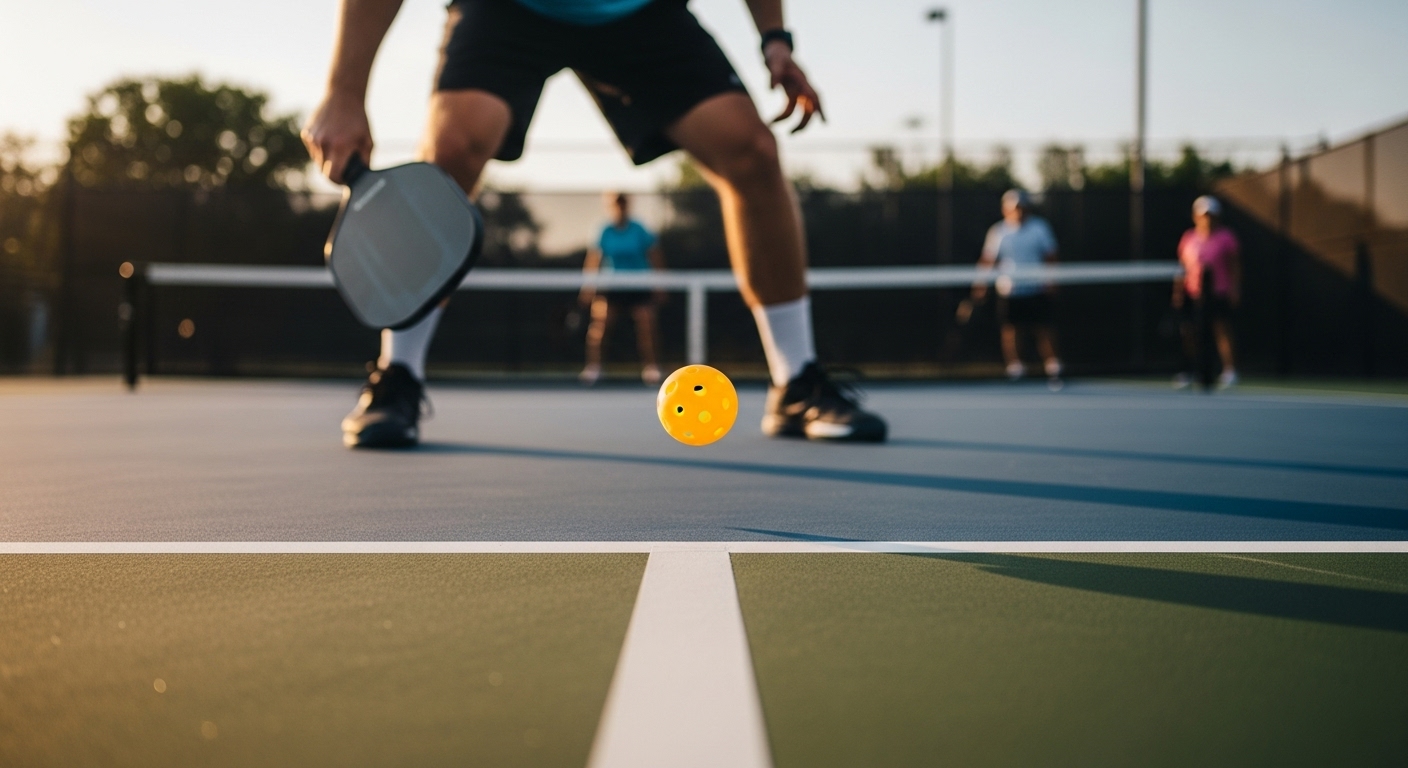
So, you think you know pickleball rules? Yeah, that’s what most of us thought too, until someone called a fault on us for stepping a toenail over the kitchen line. It’s funny how this game looks so chill from a distance. Just a paddle, a wiffle ball, and a good time. But the truth? There’s an entire mini legal system living inside those lines.
When I started playing, I figured I’d just “pick it up as I go.” Big mistake. The first time I served from the wrong side, someone said I’d violated pickleball serving rules. I laughed. Then they pointed out I’d also broken the non-volley zone rule, twice.
That’s when I realized: learning the basic pickleball rules for beginners isn’t enough. It’s the little things, the sneaky ones, that trip you up.

Rule #1: The Kitchen Isn’t for Cooking
Let’s start with the one everyone gets wrong — the pickleball kitchen rules.
The “kitchen” sounds friendly. Cozy. Like you can hang out there with your paddle. But nope — it’s officially called the non-volley zone, and it’s a danger zone. You can’t volley (hit the ball in the air) while standing in it or even touching the line.
Here’s what’s wild: you can step into the kitchen after the ball bounces, totally legal. But if you hit a volley and your momentum carries you into it, that’s still a fault. Doesn’t matter if the ball’s already gone — it’s still your fault.
If you’re diving deeper into pickleball strategies, rules, or how this sport is evolving, check out the latest insights on sports trends.
| Kitchen Rule Summary | Allowed? |
| Volley while standing in kitchen | No |
| Enter kitchen after ball bounces | Yes |
| Touch kitchen line during volley | No |
| Momentum carries you in | Still a fault |
Players call this one the “momentum curse.” Once you start rushing the net, you forget about your toes, and that’s how you end up losing a point you thought you won.

Rule #2: The Serve Is Trickier Than It Looks
Most players underestimate pickleball serving rules.
It’s not just “hit it diagonally and hope for the best.” Nope. There’s form, contact point, even spin restrictions now.
Here’s the gist:
- Serve underhand only.
- The paddle must contact the ball below your waist.
- You must keep at least one foot behind the baseline until the ball is struck.
Then there’s the drop serve. You drop the ball (no toss, no push) and hit it after it bounces. Simple? Sure. But people still mess it up by adding spin before the drop, that’s illegal under current rules.
If you’re a numbers person, the USA Pickleball Association (the official governing body) details this in their pickleball rulebook summary, Section 4.A.8. I won’t bore you with the rule code, but trust me — don’t overthink your serve, just keep it clean and underhand.
To learn more about the latest updates and techniques in pickleball and other sports, visit sports trends.
Rule #3: Scoring: It’s Not Tennis, It’s Not Ping Pong
The pickleball scoring system is where new players’ brains melt. It’s a hybrid between badminton and tennis, and it feels like it’s designed to confuse you.
First off, you only score when your team is serving.
The first number is your score, the second is your opponent’s, and the third? That’s your server number (1 or 2).
Example:
“3–2–1” means your team has 3 points, opponents have 2, and your first server is serving.
Mess up the order, and the whole rally restarts. In doubles, both partners serve before the ball goes to the other team, except at the start of a game (only one serve).
| Situation | Who Serves Next? |
| Team wins rally | Same server switches side |
| Team loses rally | Partner serves (if not yet served) |
| Both partners lose rally | Opponent team gains serve |
This one’s brutal in tournaments. I’ve seen people serve out of turn in front of refs and lose entire points.

Rule #4: Doubles: Teamwork and Timing
Pickleball doubles rules have their own rhythm. You and your partner need to move like synchronized swimmers (minus the grace). Communication is everything.
When serving, the right-side player always starts. After each point, the server switches sides, but the partner stays put until the rally ends — that’s how positions stay consistent.
One of the easiest mistakes? Both players charging the net before the ball bounces once on each side. That’s called breaking the two-bounce rule, and it’s a classic rookie error.
Another hidden trap: your partner can’t call “let” serves or faults unless the ball’s obviously dead. Only the referee (or the opposing team in recreational play) can confirm certain faults like line calls.
Basically, in doubles — less talking, more watching your feet.
Want to dive deeper into team strategies, gameplay trends, and doubles techniques? Explore the latest on sports trends.
Rule #5: Singles: More Running, Fewer Excuses
Singles are a different beast. Pickleball singles rules look simpler on paper, but they’re tougher on your body, you’re covering the entire 20×44 court alone.
Scoring’s the same, but remember the quick check: serve from the right when your score is even, from the left when it’s odd. That’s it one small math check each time.
The biggest challenge? Recovery time. There’s no partner to save you if you’re pulled wide, and singles quickly exposes who’s actually following pickleball faults and violations, think foot faults, serving errors, and stepping over baselines. For a cross-sport look at movement, serves, and court positioning, see the fast-court breakdowns at the Halle Open (ATP 500).
It’s raw. Less social, more survival.

(Pause for Breath)
We’re halfway through, and you’ve already seen how “simple” pickleball gets tangled fast. Between pickleball court dimensions, pickleball return rules, and out-of-bounds calls, there’s enough fine print to make a rule lawyer sweat.
In the next part, we’ll dive into:
- Faults you probably commit every match
- Hidden etiquette rules nobody tells you
- And those weird comparisons everyone makes (pickleball vs tennis, badminton, ping pong)

Rule #6: Faults and Violations: The Silent Killers
You know those moments when everyone stops mid-play and stares? That’s a fault. And most of us commit more of them than we realize.
Pickleball faults and violations go beyond the kitchen and serve. There’s a list of them, some so subtle they feel like traps. Here’s a few that ruin rallies quietly:
| Common Pickleball Faults | What Causes It |
| Foot on baseline during serve | Illegal serve position |
| Hitting ball before it bounces on return | Breaks two-bounce rule |
| Paddle contact above waist | Fault on serve |
| Ball hits player or clothing | Fault on hitter |
| Stepping in kitchen after volley | Classic violation |
That last one, yeah, still the #1 culprit.
What’s sneaky is momentum faults. Even if the ball’s dead, and your forward step after a volley carries you into the non-volley zone, it’s still your point to lose.
A bit cruel, maybe, but fair. The USA Pickleball Association rules are clear on it.

Rule #7: Out of Bounds Isn’t Always Obvious
We all think we can eyeball a line call. We can’t.
Pickleball line call rules are probably the most argued part of any recreational match. Officially, if any part of the ball touches the line, it’s in. That thin white edge? It counts.
But there’s etiquette here, if you’re unsure, give your opponent the call. “Benefit of the doubt” style. The pickleball etiquette and fair play standards actually expect that.
Oh, and don’t forget: calling a ball “out” too late (like after you hit it) isn’t valid. You’ve played it, it stands. That’s what separates friendly chaos from an actual match that feels respectful.
For a great comparison on precision, speed, and fair play under pressure, check out the BOSS Open Stuttgart 2025, where fast grass courts and short rallies test the same sense of judgement that pickleball players need.
Rule #8: The Serve Spin Dilemma
So… this one’s fun.
There’s been a whole debate about pickleball spin serve legality. The fancy flick-spin you see on TikTok? Yeah, that’s mostly outlawed now.
According to USAPA pickleball rules, any pre-spin imparted by your fingers (like rolling or snapping before hitting) is considered illegal. You can still create spin naturally with paddle motion, just not finger tricks.
Also, during a drop serve, no pushing, tossing, or upward motion. Drop means drop. If it looks like you guided it, technically a fault.
The main reason: fairness. Spin serves were turning games into serve-and-pray situations. Players with crazy spin could win points outright. The sport wants rallies, not magic tricks.

Rule #9: Etiquette and Unwritten Rules
You won’t find these in the official pickleball rulebook, but they matter just as much.
- Don’t celebrate opponent’s faults like you just won Wimbledon.
- Call scores clearly before every serve (seriously, no one likes confusion).
- Avoid paddle throws, even in rec games, it’s poor form.
- And maybe don’t lob seniors. That one’s just human decency.
In tournaments, pickleball rules for tournaments require clean behavior. No yelling “OUT!” mid-rally. No distracting fake shouts.
It’s supposed to be competitive and enjoyable.
A lot of folks think etiquette is fluff, but if you’ve ever had a tense match with constant rule arguments, you know why it matters.
Rule #10: The Non-Volley Zone’s Little Secrets
We’ve talked about the kitchen, sure, but the non-volley zone deserves its own spotlight. Because it’s not just about volleys. It’s about balance and awareness.
Here’s something most people miss:
If you drop your paddle, hat, or sweatband into the kitchen during a volley, it’s a fault. Even if your body didn’t cross. Equipment counts as an extension of you.
And those sneaky side boundaries? The non-volley zone extends all the way across the court, post to post. So even a wide shot can pull you dangerously close to crossing that invisible line.
The easiest trick to avoid faults here? Slow down near the net. Finish your volley, step back. Breathe. You’ll keep your point, and your dignity.

Bonus: Common Mistakes That Make You “That Player”
- Standing in the wrong service box.
- Forgetting to switch sides in doubles.
- Overhead smashes inside the kitchen (instant fault).
- Arguing calls instead of playing on.
- Assuming the same rules as tennis (they’re not the same, trust me).
The differences between pickleball singles and doubles, or between pickleball vs tennis rules, can mess with your instincts. Especially if you’re crossing over from another racket sport.
Tennis lets you volley anywhere. Pickleball? It’s like the game’s whispering, “step one inch too far and it’s all over.”
That’s part of its charm though. It rewards awareness over aggression.

Understanding Pickleball Scoring: Quickly
If scoring still feels confusing, here’s a fast refresher.
| Match Type | Serve Starts On | When You Score | Unique Rule |
| Doubles | Right court, server #1 | Only when serving | Two-bounce rule |
| Singles | Right (even score), Left (odd score) | Only when serving | No partner rotation |
There’s also a pickleball scoring explained guide in the USA Pickleball official rulebook 2025, which honestly reads like stereo instructions. The simple version?
Score on serve. Switch sides. Keep the serve if you win the rally.
That’s all you need in real play.

And That’s the Thing…
Once you’ve played long enough, you realize pickleball rules simplified aren’t about memorizing, they’re about awareness. Foot placement. Timing. Respect.
Some of the weirdest faults I’ve seen weren’t from beginners, but from players who thought they knew better.
That’s kind of the beauty of it. There’s always something to relearn.
So next time someone calls a fault on you, don’t get mad, just smile, nod, and quietly plot your comeback on the next serve.
That’s pickleball. Messy, funny, endlessly teachable.
FAQs
1. What are the 5 basic rules of pickleball?
Serve underhand, let the ball bounce once per side, avoid the kitchen on volleys, serve diagonally, and score only on your serve. Simple, but easy to mess up.
2. What are faults in pickleball?
Faults are errors made when a rule is violated, such as if you go into the kitchen during a volley, serve over your head, or hit the ball before it bounces on the return.
3. What is the non-volley zone in pickleball?
It’s the 7-foot area on both sides of the net (aka the kitchen) where you can’t volley the ball. You can step in after it bounces though.
4. How do you score points in pickleball?
You only score when serving. The server keeps serving while winning rallies, switching sides each point.
5. What’s the biggest difference between pickleball and tennis rules?
Court size and volleys. Pickleball courts are smaller, and volleys near the net are restricted by the kitchen rule, tennis lets you volley anywhere.
And yeah… that’s about it. If you read this far, you’re probably already fixing your stance or googling the International Federation of Pickleball rules. Don’t worry. We all do it after that first kitchen fault.

I’m Oliver Scott, and I live to bring every sports moment to life. Get breaking multi-sport news, in-depth match highlights, fantasy tips, athlete spotlights, and the latest trends right here.